
TLDR Gist: For the first time, the potential collapse of the Iranian regime is a real risk, which is not covered or reported at all on conventional media sites main pages at all. Narratives are entirely revolving around Venezuela and Greenland at the moment, and on oil, but the real largest macro event this year might be the fall of the Ayatollah’s regime, because of Iran’s singular ability to fund and back ALL of terrorist regimes and proxies in the Middle East; it’s large support in drones and missiles for the Russian military advance; it’s role in the Petroyuan ambitions by China and the INSTC energy framework, as well as China’s dream of the Alternative Energy Routes to bypass the Malacca Dilemma. Iran represents hundreds of billions of active Chinese investment.
And so while conventional narrative remains on other macro distractions, I believe the US intelligence community understands that this is the one chance to permanently shift the dynamics and calculus of the Middle East
And because of the strategic importance and essential nature of Iran to China and Russian ambitions, we might be close to seeing a desperate fight for influence amongst great powers. This by no means state that the Iranian regime is likely to collapse; the argument lies in the elevated risk of an Iranian regime collapse (whilst recognising the historical resilience of authoritarian regimes), and as such brings the potential of either generational change in the global geopolitical balance of power, or great power elevated tensions
Latest Reading: https://www.criticalthreats.org/analysis/iran-update-january-9-2026
Apologise for the lack of sources and citations added, prioritised information dump rather than writing conventions.
According to the article “The Weakness of the Strongmen: What Really Threatens Authoritarians?“ the author Stephen Kortkin, Senior Fellow at the Hoover Institute at Stanford University posited authoritarian regimes collapse when these pillars are threatened:
- The Iron Fist: no authoritarian regime can survive without security police and military forces capable of domestic repression. Previously, Iran relied on the Shah secret police, the SAVAK, which was reformed into the SAVAMA
- Cash Rules Everything Around Me: Nature of the regime’s revenue streams. Authoritarian regimes prefer not to depend on just taxation and have alternative sources of revenue, and while such regimes do not usually have a social contract (no imperative to satisfy the material aspirations of ordinary people) and can survive with little or no economic growth, they cannot survive without cash flow
- Tall Tales: The nature of the stories the regime tells about itself, and actively seeking to suppress the stories they do not want their people to see.
- The Deciders: The control that a regime exerts over life chances, and ability to influence the opportunities its citizens get. The more the state is the largest employer, the harder is it for people to refuse to praise it or speak out against it.
- Conducive or Corrosive: Is the geopolitical environment in which it exists supportive? What is the state of their alliances and trust?
The Current State of Iran
BIG CAVEAT: most sources are alternative channels at the moment, some information might be from sources that are incredibly biased as well
The protests began on 28th December amid accumulated social and economic grievances and expanded from trade and market-based demands to street protests and subsequently to universities. Main stem is the sharp fall in the value of the Iranian Rial and the cost of living. Inflation is above 40% and Rial has dropped to 1.4mm per USD. The regime decided to simultaneously scrap subsidies and price controls, causing basic imports to skyrocket overnight. The monthly handout of $7 per month is viewed by the public as entirely futile
Demands have grown wider into political protests and structural criticism, while the government has sought to contorl the scope of protests and public reflection. Main channels are on-ground control, judicial and security pressure and communication restrictions
On the ground sources reflect that slogans and messaging remain categorised into the 2 main themes of livelihood related grievances and economic pressures and structural political criticisms, and in the minds of protestors both are 2 interconnected as
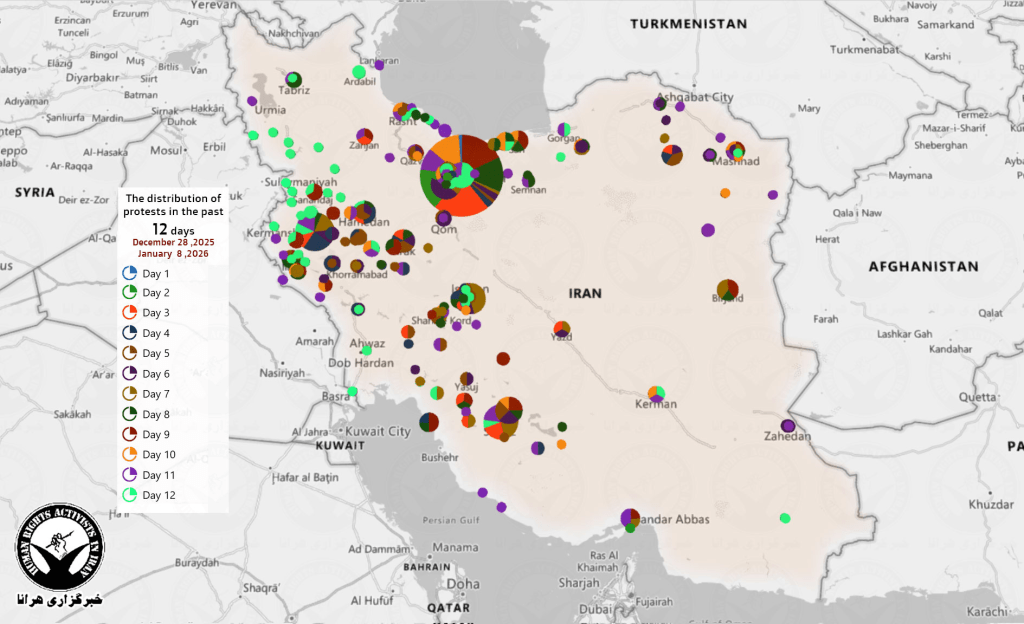
- Huge unprecedented protests for 10 straight days
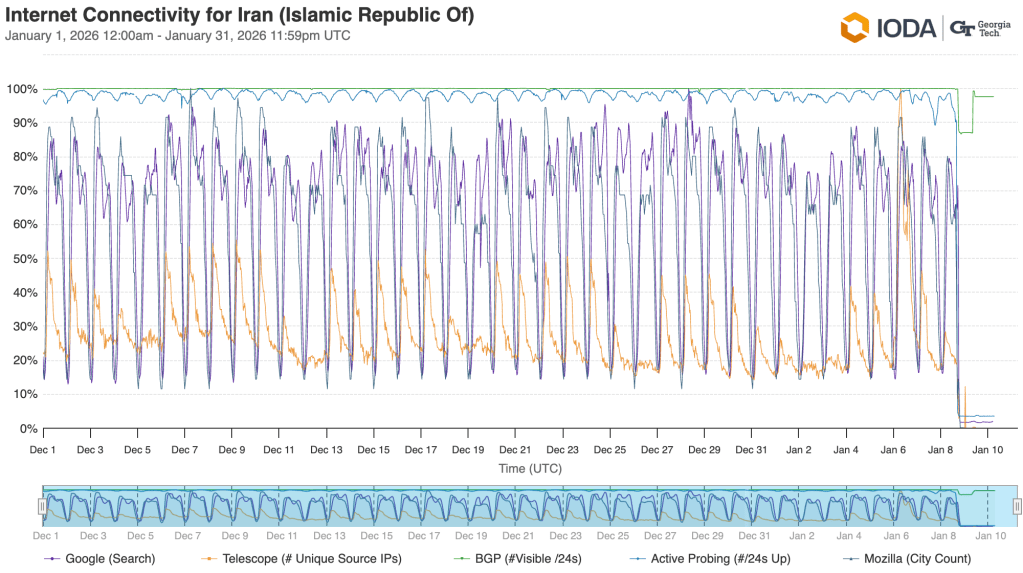
- Iran has shut off all lines of communication, internet, cut landlines. Satellite technologies are not working, domestic internet is down as well. Starlink satellite effectiveness is also jammed
- Interestingly to note the ability to disrupt Starlink satellite technology is traditionally not associated with Iranian level of technologies, which potentially hints at not a total inability of Russia or China to continue support for Iran. Russia has demonstrated the most visible and proven abiliyt to disrupt Starlink in Ukraine and China was evaluated to be developing such Starlink-targeted tech in late November 2025.
- The protests in Iran have spread to 111 Cities and Towns across all 31 provinces. Total number of detainees stand at more than 2,277 individuals, with 166 university students. Death toll stands at 42 individuals
Internet usage has collapsed
Videos from on the ground sentiment, prior to the internet shut off are showing protesters calling for regime change
2nd largest city in Iran Mashad has fallen, millions protesting on the streete
Karaj & Tehran: People have taken back control in the areas where IRGC massacres have occured
IRGC has fled several cities including Rasht
Medics and hospitals are currently overwhelmed with injured personnel, 200+ killed in protests by 13th day
The Iron Fist
- Following Operation Grim Beeper, the Iranian IRGC has critically lost the ability and trust in communication devices, and interoperation within the IRGC and leveraged forces has deteriorated significantly, allowing for the significant continuity in fall of cities
- https://www.youtube.com/live/gGeZzNi5EO0?si=LlmAwZseNIGHDCZa
- Iranians destroy the IRGC forces in capital and Ayatollah Khamenei has been moved to Bunker
- Talks that Russia is ready to extradite Ayatollah to Moscow
- Iran has just put in place the death penalty for rioters https://www.bloomberg.com/news/articles/2026-01-09/iran-threatens-protesters-with-death-penalty-as-crackdown-grows
In 2025; Israel:
- Killed Iran’s top nuclear negotiators
- Barraged Tehran’s nuclear sites
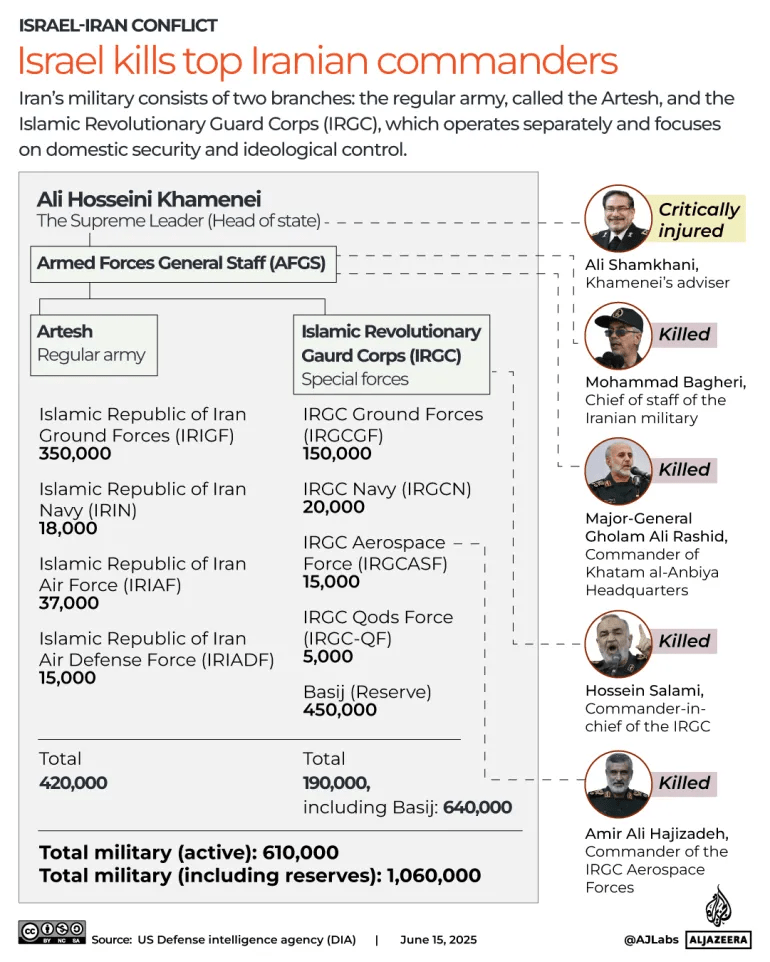
- Assassinated the heads of the IRGC, including:
- Hossein Salami, Head of the IRGC
- Mohammad Bagheri, Chief of Staff Iran Armed Forces
- Gholamali Rashid, Commander of Khatam al-Anbiya Central Headquarters
- Amir Ali Hajizadeh, Commander IRGC Aerospace forces
Evidence of Iran using Hezbollah, Houthis and terrorist operatives now to suppress riots: https://www.iranintl.com/en/202601071907
There is increasing suggestions that rank and file members of the IRGC, including the Basij (paramilitary) and Law Enforcement Command (LEC) are refusing to fire on their own civilians. And there are reports that show roughly 800-850 foreign fighters (Hezbollah, Houthis) have crossed into Iran to bolster security forces during the ongoing uprising. This practice has happened before, during the 2009 Green Movement and the 2019 fuel protests, but this deployment is occurring at a time when these proxies themselves are weakened and more desperate for the regime’s survival.
Additionally, the fall of Syria had devastating consequences for Iran. Syria previously had a critical use as a land corridor connecting Iran to the Mediterranean and to Hezbollah in Lebanon. Syrian ports provided transhipment points for Iranian weaponry, allowed IRGC advisors to operate with relative freedom in Syrian airspace, and housed Iranian training camps and HQs. The collapse of Assad in December 2024, severed the land corridor connecting Iran to the Mediterranean, and Iran lost its only state-level ally in the Middle East

Cash Rules Everything Around Me
- Funding sources for Iran are collapsing: Venezuela used to be part of an illicit and huge money laundering scheme and facilitated extensive military arms sales for Iran. On 30 December 2025, the US sanctioned 10 entities based in Iran and Venezuela, which contributed to the sales of Iranian UAVs and ballistic missiles (https://www.state.gov/releases/office-of-the-spokesperson/2025/12/disrupting-irans-uav-proliferation-to-venezuela-and-irans-weapons-programs).
- For more than a decade, Venezuela acted as the designed way for Iran to circumvent sanctions, and the alignment of governments in Tehran and Caracas were incredibly important. Their
- Iran claims to have been able to withdraw about $2 billion worth of funds (https://www.iranintl.com/en/202601053640). Overall estimates of Iranian cumulative financial exposure and investment in Venezuela total about $8 billion (https://iranwire.com/en/features/147425-what-happens-to-irans-investments-and-claims-in-venezuela/). The nature of these investments are largely believed to be illiquid and infungible, and in late 2025, Iranian lawmakers established claims that outstanding debt (in excess of assets) totalled $2-4 billion, but such estimates are likely highly speculative because leadership in Iran have given conflicting claims (Majidreza Hariri, Head of Iran-China Joint Chamber of Commerce claimed he was unclear on the source of the $2 billion claim).
- The US in late 2025 froze $15bn in crypto assets related to the Cambodian Prince Group. Analysis by Elliptic and Arkham of blockchain addresses point towards the Prince Group funds channeling had operations in Iran and China
- Oil prices are at very suppressed levels, affecting Iranian oil export revenues.
All of these funding weaknesses affect their ability to continue operations and fund proxies
Tall Tales
- Main slogan now is “Death to the Supreme Leader”
- https://www.youtube.com/watch?v=a77J3gCeY-g
- And there is a much stronger and broader push towards overthrowing the regime unlike before in the Mahsa Amini riots
There actually have been mention of “Long live the Shah” in some of the protests. I think its interesting that the Iranians generally regret the fall of the Shah back in 1979, and that his son is living in the US, and has been talking about facilitating regime change in a manner that is consistent with the will of the people. I do believe that there is a credible possibility that all of this has concerted US intelligence involvement; i.e. Trump this week spoke on the son Reza Pahlavi, and called him a nice person
Also the nexus of the Iranian regime is that people predominantly identify very proudly as Persians, and only 5% of the population align with the traditional religious values of the Ayatollah. Persians make up more than 50% of the country’s population, and contrasts with the Shii-Iranian religious dominance of the incumbent regime. So the religious alignment is not entirely robust here
The air of invulnerability surrounding the IRGC, which the IRGC has painfully built over the decades, has collapsed with the killing of the top brass and leadership in the 12-day war.
The Deciders
- people are targeting the Department of Education and tearing down banners of the Ayatollah, and the strategies such as turning off street lights are only making it harder for the IRGC to identify protestors
- back in the 1979 Iranian shah revolution, the movement was backed financially and logistically by the bazaaries (merchant class). unlike the 1999 student protest, green movement 2009, 2022 mahsa amiri riots, this current protests are the ones where the uprising has originated from the bazaars
- the energy sector has in a rare move entered the energy strike: the council for organising protests of oil control workers (COPOCW) initiated the strikes in the south pars gas fields and asaluyeh petrochemical complex, and 5000-30,000 workers have ceased operations, so the sustained oil strike is an existential threat for the regime
Conducive or Corrosive
- The global environment: Russian support has been weak for Iran, and Iran’s proxies are weakened after Israeli strikes through most of 2025, leaving Iran in a vulnerable position
- Article by the Institute for Study of War (ISW) in November 2025 reported Iranian officials had began to express that their proxies had begun to become less responsive to Tehran, and “its not just the Houthis, some Iranian backed groups in Iraq are also behaving as though Iran has never had any contact with them”. Some Iraqi militias have repeatedly ignored Iranian directives to pause training until tensions subside
- https://understandingwar.org/research/middle-east/iran-update-november-25-2025/
Historical Precedent and Differences this time: Playbook Analysis
*Highlighted represents what is the same now
The largest protest since the collapse of the Shah: 2022 Mahsa Amini
- Protests and unrest started in September 2022 and ended in Spring 2023, with political leadership unchanged and firmly entrenched in power
- Iran responded to the unrest with widespread internet blackouts, nationwide restrictions on social media usage, tear gas and gunfire
Why it failed:
- Regime’s decisive and unwavering repression of the protest, policy of crushing the protest rather than meeting any calls for change.
- But now there is the inability to do this punitively: across the largest geographical riots in Iran and the total breakdown in communication ability + leadership killed by Israel, the military is semi-crippled in Iran
- Lack of incentives to follow human rights accords. THOUGH the iranian regime is keenly aware that the weakness the Shah displayed in 1979 was the main contributing factor to the regime’s collapse, and is obsessed with not repeating the same mistake again.
- Regime effective control on the media:
- effective manipulation on the narrative of the protests, playing on nationalist emortion and conspiracies pertaining to the terrorism by ethnic minorities including the Kurds
- Use of old and fake footage to lie about the protests
- The use of the National Information Network, which can enforce digital curfews that made it almost impossible to communicate with the outside world, as well as controlling electronic communication at a granular level, directing mobile internet carriers to cut service entirely when a province becomes restive . Internet traffic fell to a low of 25% during the blackouts relative to regular usage,
- Weakening of the “Maximum Pressure” Campaign against Iran under the Biden Administration, which increased Iranian oil export revenues to fund the IRGC to fulfill its mandate. According to the United Against Nuclear Iran thinktank, the IRGC’s official budget ballooned from $900mm in 2020 to $3.6bn in 2022, with oil export revenues growing proportionately
- Lack of central organisation and leadership: some in the riots wanted regime change the others wanted gradual reform, and since the protests were more geographically spead the lack of leadership confined them
- But this is also different now: back then it was about Hijabs and womens’ rights at the core which sparked this, now its the economic conditions and the people broadly are suffering, which i think brings more passion than women riots in Iran. Also right now Trump is warning Iran that Iranian repression will be definitely met by US strikes on Iran, and Trump has shown no aversion to direct military intervention . And crucially; Iran has military conscription! This current wave is “drive mainly by young men”, who are trained in the military and more capable of fighting the regime, especially when the IRGC is weakened
- https://www.dailysabah.com/world/mid-east/spreading-protests-expose-legitimacy-crisis-for-irans-leadership/amp
- Eagerness for the protests greatly diminished as time went on, as people started to think that the reforms and regime change were not possible
The Macro Importance of Iran to the Axis of Aggressors
- Iran’s massive provision of drones and weapons technology to fund Russia’s military operations. Through the Russia-Ukraine war, Iran has been by far the most supportive of the Russian conquest, whilst China has been tapered
- Iran as the central base and funder of all Middle East terrorism, and the reliance of China and Russia on Iranian influence for petroyuan and disrupting American influence in the region
- Iran provides ammunition and thousands of Shahed suicide drones. Useful to note that recent discoveries include Russian Shahed drone production line now operates largely without Iranian involvement in Tatarstan, and latest models recovered in Ukraine have been equipped with Chinese rather than Iranian engines. Likely just a miltary asset diversification and there are still Iranian Shahed-107 munitions found at the frontlines of the Ukraine conflict
- https://www.washingtoninstitute.org/policy-analysis/irans-failing-eastward-pivot-limits-and-risks-russia-china-alignment
- The positioning of proxy forces across multiple theatres from the Levant to the Arabian Peninsula to the Persian Gulf, Iran creates an asymmetric advantage through forward deployed proxies and allows Iran to control critical maritime chokepoints: the Straits of Hormuz, Bab el-Mandab Strait. Also allowed Iran to wage multi-front wars without direct military confrontation
WHILST Tehran only has an agreement with China below the “all weather” status (below pakistan as well), Russia has not designated Iran as a tier-1 partner at the level of Belarus (mainly due to cost considerations)
- Iran and China’s relationship is deeply rooted in history and stretches back centuries to the Silk Road.
- Iran is a natural partner for China, with its vast energy resources and China as the global leader in energy consumption
- Iran is central to China’s middle east stabilising strategy
- Iran has the potential to resolve China’s Melacca Dilemma, by supplying the bulk of China’s sanctioned oil (90% of Iran total oil exports are to China) through an infrastructure that China has spent a very long time to establish. Covert payment mechanism is through Sinosure and Chuxin and the opaque estimates are around $8.4bn in oil flows for infrastructure
- Iran represents the geographic linchpin for China’s alternative energy corridors: International North-South Transport Corridor, China-Iran-Europe Rail corridor represents hundreds of billions of USD of investment in Chinese infrastructure
- In 2018, China launched yuan-denominated crude oil futures on the Shanghai International Energy Exchange with the explicit goal of de-dollarising global energy trade . Iran, with Russia, Venezuela, Saudi Arabia, UAE and Egypt now trade oil in petroyuan. Iran is essential to this broader financial architecture, and the collapse of Iran will almost certainly dismantle the oil-for-infrastructure payment system with China and terminate current agreements, and petroyuan is only a credible threat with Iran involvement
- Iran represents the southern strategic anchor preventing Western encirclement and the bridge that connects Russia’s vision of a Greater Eurasia, and reflects Russia’s vulnerability on its southern borders. Russia needs Iran to prevent Western influence from expanding through the Caucasus and Central Asia: INSTC framework connecting Russia to the Persian gulf via Iranian territory would evaporate, Western powers will be able to threaten Russian interests in the Caspian sea.
- Russia strategic doctrine hinges on Iran as a stabilising force and buffer against Western encroachment in Central Asia, Caucasus and Caspian region. This is even more important now, as Russia faces isolation from Europe and is forced to deepen ties with Asia, and losing Iran is a catastrophic loss of a friendly state on Russia’s southern flank
- Iran provides Russia and China the ability to, through its IRGC and proxy networks, project power without direct military commitment from each country.
- Iran’s participation in the broader calculus of a ideological imperative, as part of both’s vision of a multipolar world order that challenges US hegemony. Iran is formal member of the Shanghai Cooperation Organisation and BRICS
- Total Investment by both is near a trillion, with planned investments ranging across energy, banking, telecommunication and transportation for China; and the INSTC, Rasht-Astara railway project, military tech cooperation agreements with Russia. These represent years of relationship building and institutional commitment
- Since Venezuela started to become largely unavailable as an oil partner, China has been strengthening its relationship with Iran, and with Venezuela closed, they will likely want to import more from Iran ~ Ex-India diplomat
And from the 2024 collapse of the Syrian regime, Russia and China are aware of how Assad’s fall created the power vacuum Israel and Turkey are now exploiting.
What Happens if Iran Collapses?
- China loses 90% of its sanctioned oil supply
- Pertroyuan architecture is dismantled
- Alternative overland energy corridors to tackle the Malacca Dilemma collapses
- Western control of the entire Persian Gulf energy supply
- Other sanctioned partners lose confidence Beijing and Moscow can be relied upon as alternatives to the Western backed order
- Russia becomes strategically encircled from the south and loses the Caspian sea influence
- Russia loses the INSTC and a buffer state
- Both lose the multipolarity project that has been 2 decades in the making
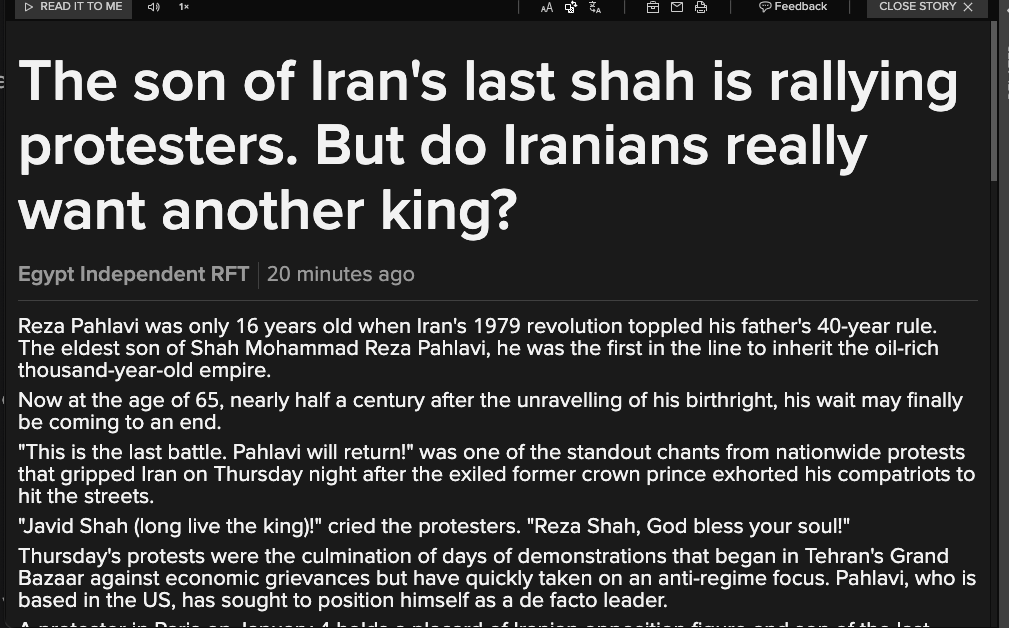
The Son of the Shah is Back?
- Exiled guy, was the son of the last Shah of Iran back in 1979
- Based in the US, and Trump called him a “nice guy”
- More and more articles and things he’s doing out there that is riling up the crowds in Iran behind him, and he might be the guy the US relies on
Though
- Despite the scale of current projects, much like the Mahsa Amini riots, there is no current unified leadership leading the protests in the country, with the labour unions, ethnic groups all operating in silo
- Iran’s military IS the economy. If the US were to make any moves targeted at Iran, they will likely meet an oil and energy global escalation vastly unlike the Venezuela incident
 Palm Holdings
Leave a comment